3.22.2011

Refinish, restore, refresh…


Teak Arm Chairs for Unknown by Unknown – 1950s (est.).   These chairs are a simple beauty in the eye of the beholder story.   I wish I had a before picture as the story would be easy to see.   The seller purchased and used these chairs as a bridge to the designer chairs he really wanted.  When the kids left for school, these were out and the named chairs were in.   For this reason, he never truly cared for these very nice chairs, and moreover didn’t care to pay to have the totally worn (and ugly, really ugly) cushions redone.    This was understood and the chairs were priced accordingly.  

The work (my work) was pretty simple.   There was no reason to do a total rework on these as some simple teak oil coating brought the wood back to life.    The cushions were another story.   The foam was dead and the zippers were not working.   New cushions were an easy decision.   It is important (to me at least), to keep things correct, namely to use period correct fabric when reupholstering is called for.  In this case, I went with a manufacturer who has been making Danish fabrics for many decades.    None of my projects are without a story, and this one is no different.  I decided it best to order the fabric direct from the manufacturer and then farm out the work to a local upholstery shop.    UPS tracking said the fabric was delivered, but I could not find it at my house despite an (overly) extensive search of all surrounding bushes.   Always read the fine print – a few misplaced numbers and names, and the fabric ends up on the other side of town.    Luckily I was able to find the person at the wrong address and of course my fabric.  

In all, I am into these chairs to a level that is probably fair value, so this is not a “value creation” project.   As with the person I purchased these chairs from, these chairs are going to end up as a bridge to another set of chairs that I would find months after having these reupholstered.  I would be happy to discuss my thoughts on fabric suppliers and upholstery shops with interested parties.  

3.15.2011

Refinish, restore, remember…


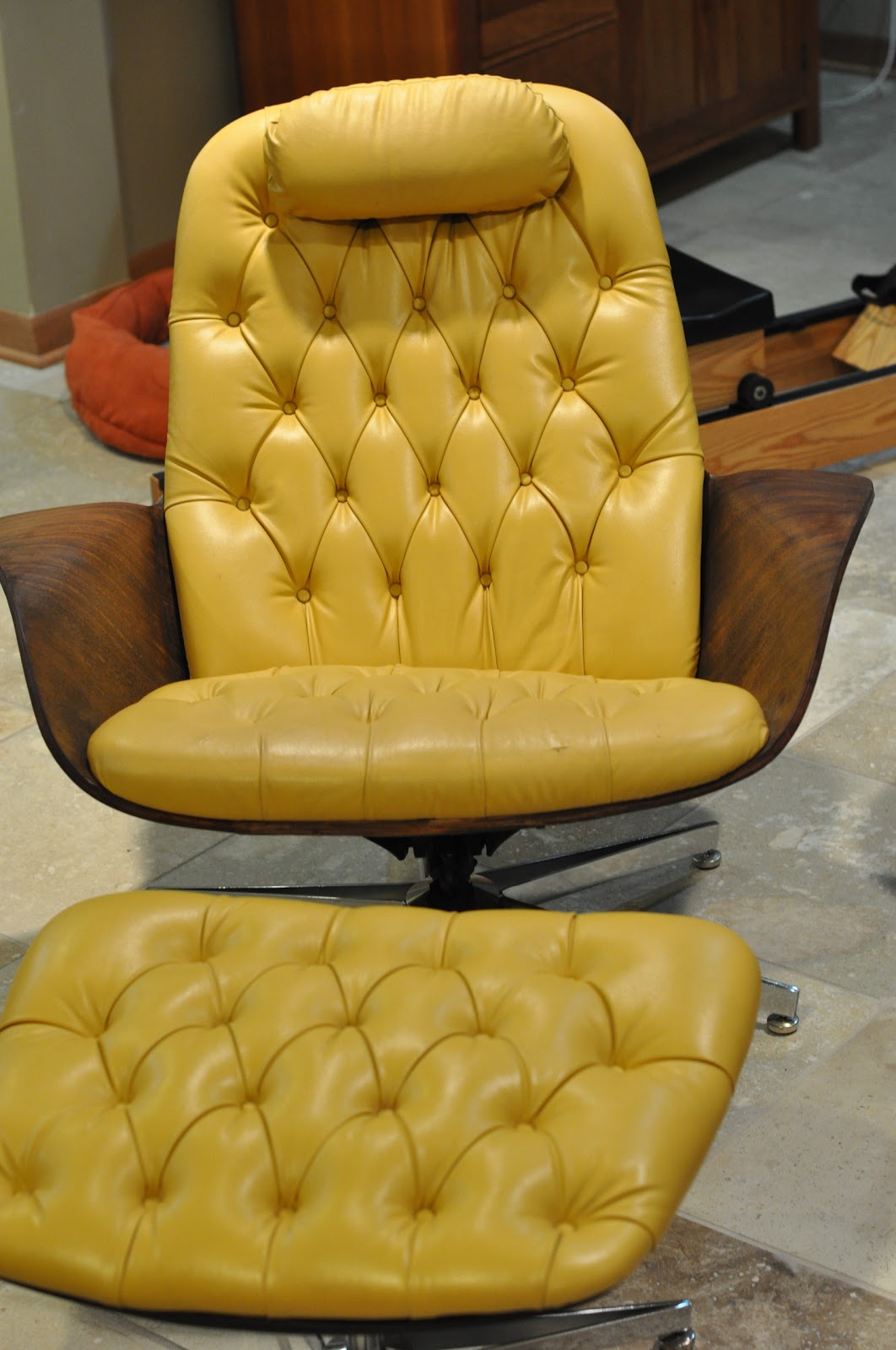
Mr. Chair for Plycraft by George Mulhauser – 1950s.   Mulhauser, and Plycraft for that matter, are probably best known as the mind(s) behind one of the better selling knock-offs of the seminal Eames Lounge Chair.   While not a bad chair in and of itself, the original is infinitely more palatable (flow, dimensions, etc.).    What has gone missing, at least to me, is the genius of the Mr. Chair.   Mr. Chair is an original design of the same era of the Eames Lounger.    One cannot help but wonder how Plycraft, and Mulhauser for that matter, might be seen had they come to be known for things like Mr. Chair instead of being the poor man’s Eames.   Fair disclosure – I have an Eames Lounger, and bought this as I wanted another of era original lounge chair that was meaningfully different.

While advertised as ready to roll, this one took some work, and will need more as the mechanical pieces are not an easy fix.  The seller (and his friend) started picking up items are garage sales over ten years ago (an “OG” if you will).   With baby #2 on the way, he was politely told that it was time to start getting rid of some stuff.   He wanted at least $250 for it, and I was able to take it home for $250 as the seller ended up living in my neighborhood and he also seemed to like that I planned on giving his old chair some TLC.   As with other projects, being “real” in the sourcing phase pays dividends.    This guy came to me in pretty bad shape – the arms were fully covered with the original yellow naugahyde (swank baby, swank), and the plywood was raw, dry.   The chair is essentially just a few pieces of cleverly bend ply with cushions – all hardware is exposed.   I decided to take it apart and refinish everything.   The back of the chair has a significant abrasion.  I was able to fill it and smooth it, but the scar is easy to see.   In addition, the seat panel of the chair was damaged by over-tightening of the base structure hardware some years ago.   I was able to fix most of the damage, but it remains another scar.    I decided to stain the ply dark as it appears that this was the designer’s original intent.  I also decided to keep the yellow pads – they look much better against the darker exposed wood that I expected.  As for the mechanical – the seat adjustment mechanism is missing what I assume to be a large rubber stopper.   I will need to keep an eye open for something that will work as original parts are hard to come by.   In the mean time, sitters need to be mindful of the lack of dampening as the chair rocks back into lounge position. 

I think a lot of people would have been upset to find the scars on this chair during the reworking process.  As with many of my other pieces, I like the story, especially the story of the designer and manufacturer.  It seems only fitting that this chair be a little less perfect than my Eames Lounger.  This is another beauty in the eye of the beholder case study, especially after the scars were discovered.        

In all, I am into this guy for $250 and a few days of work.   This is difficult to comp given the scars.   Models that claim to be in good shape appear to go for as much as ~$1,000.   I think $500 is probably fair for mine, especially as the models I have seen out there are all very plan black upholstery and mine has the swank yellow.

I am not looking to sell this chair at current, but if you are interested in finding one, or something similar, please ping me on the blog and we can go from there.  Given the extensive work I did on mine, I will also claim to be one of the few people around who has working knowledge of this chair to refinish another.  

3.08.2011

Retask, reclaim, rethink…


Design Idea – Wine Corks.  Wine cork presentation is an easy way to add warmth and dimension.   As with the bottles I mention in another post, the shape is pleasing to the eye.   Corks are another interesting way to add round and curved shapes to a room, which isn’t easy.   Natural cork is also not as prevalent as it once was, making the presentation almost a form of antiquing.  

Here I show a few ways we use old bottles.   In the first, I simply fill a clear vessel with corks and display them among other objects.   In the second, I have taken the corks and created a custom cork board.  The frame was built using remnant tongue and groove flooring and some thin plywood as the backing.    One could just as easily use a store-bought new or vintage frame and some cardboard to create the structure and simply glue corks on as you see fit.     

A special thanks to Chase for getting me the pics of the cork board. 

2.21.2011

Recycle, retask, rethink…


#1 The Audacity of Capitalism, Personal Accountability and Contract Law & #2 Hope and Change; Change and Hope by JLS for JLS – 2008 thru 2010. I created these pieces during a period of general worldwide depression. The economy was in a nose-dive, basic systems were failing or being bailed out by a government that lost its mind…and all of this was covered best by the dying media that is the newspaper.

The visual theme was to cobble together newspaper clippings that spoke to me at the time, and to group them/apply them in a way that might suggest a wall in a busy city where one might find posters pasted without regard for the one next to it, under it, below it, etc. The depth and layering is also meant to suggest that there is always more to the story (the piece in question just scratches the surface). The use of headlines only or perhaps graphics only suggests that some messages are just that simple and don't need more. In any case, these boards capture a period of time in our history where there was a decent chance that the engines really would stop (respect to John Galt). This is my case..one might also argue that this is the visual result of one man's temporary (and perhaps ongoing?) insanity brought on by overexposure to gloom and doom reporting. In any case…

Structurally, these boards are simply plywood. I have applied layers of newsprint pages to the raw board to produce a less even base texture (overlapping pages create small seems). Over this I have laid the clips that I collected from a variety of sources, but mostly the Wall Street Journal and Financial Times, the two papers that I get to see daily in my "professional" life, with other periodicals of a similar "theme" represented as well. The clips are then sealed with an acrylic medium (multiple layers). The final effect is inconsistent – sometimes smooth, sometimes slightly wrinkled, sometimes clear, sometimes a little foggy. This was by design. The clips are often off-center, cut with less than square edges, and the edges of the boards are not well finished…all by design.

I have produced two "series" so far. The first is a four piece series that I titled "The Audacity of Capitalism, Personal Accountability and Contract Law". These boards are the largest pieces, coming in at 4' wide by 6' high, and weighing a decent lot. The second is a three piece series that I titled "Hope and Change; Change and Hope". These boards are smaller than series one, and measure 2' wide by 4' high. The photo you see here is one of the first series.


The original intent with these pieces was simply a method of expression for the artist. After the first one didn't totally suck, I kept going as the materials were flowing out of the media at the time. When I ran out of wall space in my main room, I decided to do a second series, if only to make sure that the best clips were protected and used. While the materials may not be as easy to find anymore, I have more items that I think would make for great pieces and I continue to collect more as I find them. Where series one was directed more at the potential for imminent destruction of our financial system, series two started to introduce more melancholy humor, and I think the pieces that I plan to create from here will use these themes as well as introduce items that represent what can only be called "asinine bravado", something many of us (me perhaps more than most) thought would remain absent from society for a while after so many issues were exposed a few years ago.


As with most art, these pieces aren't for everyone. The most rewarding thing for me is to see that these pieces absolutely stir some emotion in everyone who sees them – joy, despair, wonder, fear, bewilderment, curiosity, etc. I have had offers to purchase these, and I would love the chance to show them somewhere with more traffic to see how a larger group of people react. I cannot part with series one given the emotional attachment I have to what was going on (if only with me) when they were produced. Series two is also likely not for sale, but I would entertain offers. I do plan to go back into production in short order and would love to hear from people if they are interested in purchasing one of series three (haven't decided on sizes yet, but probably a few like series one and a few like series two). If you have interest, ping me on the blog and we can talk offline.

2.14.2011

2.12.2011

Reclaim, retask, remember…


Timber Bench for JLS by JLS – 2008. The name says it all with this project. This is simply a "slice" of a douglas fir timber that I have used to create a bench. This is among the most conceptual pieces I have created, and the nuance may go unnoticed at first glance. The timber itself is massive, and weighs around 150lbs. The terms substantial, solid, and planted, among others, come to mind when I look at a timber like this. Juxtaposition – the timber appears to float just above the ground, perhaps not as substantial, solid and planted as it should be. The initial user reaction is just that – one feels secure sitting on it until you see that it looks like it might not be as it seems, but is that even possible?

The work behind this one was far less that other projects (manual labor), but the sourcing took more time. Timber like this isn't widely available, and many sources charge through the nose based on this. As with most things, if you can get to the supplier to your would-be supplier, then you are better off. That was the case here, and I was able to find a better piece at a better price…but it also required a little road trip. Many retailers have offered ottoman-like or table pieces that are cut from similar timbers. Unfortunately, these and similar mass-market timber items are generally designed to fail. As you can see, my timber has a slightly warm hew – it isn't "raw" wood. This is purposeful. As I did my research, I came to better understand the relationship between the cellular properties of timbers and their size – the big guys survive longer as big guys because the ratio of exposed (face-cut) area to their length (cut
along the fibrous direction, not against) is high. When this ratio gets too low (I am sure that is some Gladwell-esk "tipping point", but I am not going to get that deep into it), the timber pieces simply dry out and fall apart, sometimes in short order. In order to prevent this, you need to bind the fibers, in essence glue the timber together before it falls apart. I accomplished this using a simple wood working oil finish with a natural tone. While my timber is not as "raw" as the trendy items you can find around the way, it will still be useful in its current form in five years. Mine also has a bit of character, a slight dent in the corner. This would simply not do for most retail customer, but in my case, it is part of the story. When I picked the timber up from the mill, the operations were closed (summer day off). My sales contact decided to roll along anyway and loaded the timber on the lift…and proceeded to drop it
within inches of my truck. He offered another piece, but in the spirit of keeping expectations reasonable and that I like my pieces to have a story, I could not bring myself to replace what had become "my" timber.

As with other projects I have discussed and plan to discuss on this site, the amount of information I learned during this project was worth it at twice the price. In this case, I am happily in the money on a mark to market basis, based on the comparable timber pieces I have seen around the way.
This bench is not for sale, but I would gladly entertain discussions with parties interested in the concept and in having something similar made to order.

2.10.2011

Let’s talk “green”.

I mentioned in the first post here that this is not a “green” movement site.    This of course didn’t stop someone who will remain nameless (Chase) from calling me out.    My position on “green” will become more apparent as we get into more spring and summer seasonal topics, but I thought it would make sense to lay the groundwork today, if only because I am feeling a little riled up for some reason anyway.

The “green” movement, and by this I mean the stuff that is being pushed on people and that has suddenly popped up everywhere is garbage, in both the literal and figurative sense.     In the literal sense, people are being guilted and pressured by “experts” into buying stuff that either doesn’t work or is just more of the same manufactured plastic junk in another form that they may or may not recycle when this fad dies and the next big thing is what everyone is doing so hop to.   In the figurative sense, it is still consumption, which to me is the easiest thing to cut out if you want to be “green”.     Reduce simply isn’t something to keep in mind as a measurement on the sticker of the new thing you just bought, it is something to think about before buying anything at all (hey, my new toilet uses less water – but so does your old one if you just put a brick in the tank like people did in the depression to save money).

As I have mentioned or will mention, part of what drives me to do some of the weird things I do is the simple question – something is what it is, but can it be more?   I am fascinated by reuse, which is part of being “green”, so I felt the need to address this topic, and probably will do more in the future (even though my focus on reuse was not founded on a desire to be “green”).   It seems that the “thought leaders” whom you can find with a quick Google search are not willing to ask the real questions.   Instead of trying to find you a “greener” car (are batteries really green anyway, and dont these cars still need oil in a lot of places), why not ask if you need to live 60 miles from where you work/play/etc.?   Instead of looking for “organic” fertilizer for your lawn, why not replace the out-of-place turf with natural indigenous grasses and stop using fertilizer (and probably so much water) in the first place?     At the same time, I am not saying that people should be forced to live at work or that preventing you from planting grass of your choice should be a “mandate”, but let’s get real, mad real yo.

It isn’t realistic claim that you are being “green” by simply buying some other thing that makes you feel better about a decision that is obviously a concern for you.   Undo the real issue if you want to do something real, if not, get over it..and stop being pushed around and guilted into a fake lifestyle by people who disguise themselves as friends of the environment when they just want your money.   With that, I look forward to showing you some things in the near future that are really “green”, and also cheap.

2.09.2011

Item - somene needs to buy this desk because I cannot

Every so often I plan on posting something that I would like to buy but cannot for various reasons.   This item is a perfect example.   This crazy cool Jens Risom desk needs some love, but is priced to move.   I checked it out last night.   It is huge, and heavy, and too much for my place at the moment.   The buyer would likely need to refinish most of the desk (some light sanding and oiling).  The top is potentially problematic as it appears to have been replaced, or at least covered, in some kind of plastic laminant material.   If this were mine, I would look to either cover this in leather, as some models were made originally, or have someone in the trade reproduce a proper teak top to bring this desk back to its original amazing self.    In any case, this is an easy do for someone looking for a cool piece that will more than pay for the work you need to put into it. 

2.08.2011

Refinish, retask, recycle, rethink…


Bowling Alley Dining Table by JLS for JLS - 2008. The legs are a standard "Parsons" flavor, and the top that appears to be a butcher-block (rather "strip") is a reclaimed bowling alley (the ball marks and errant nail fill marks don't lie). Wood alleys require full replacement every ten(ish) years, or so I am told, and the used sections are often simply pitched. I found this shocking. Under all the plasticized surface preparation and wax is beautiful maple. For reference, the outer frame of the table is "new" maple, and the four boards cost me nearly as much as the section of alley, which again is the SAME material.

This piece was challenging in a number of ways. First, the alley sections are heavy, like three men and a truck heavy. Whereas most of my other projects allow for some post positioning maneuvering, I needed to plan ahead for this one and create a work set up that allowed me to complete everything without moving the section during the work. Second, these sections are not built for reworking or simple modification. Nails are everywhere, and of meaningful girth. My table saw ate threw them, but not without some significant sparking and noise. Again, initial planning was important as I could not stop cutting to move a too-close can of flammables, for instance. The surface prep alley installers apply is also industrial strength, especially when compared to other surface prep materials a traditional furniture refinisher may have encountered over time…think an eighth to a quarter inch of hard transparent plastic. The streets taught me neverto bring a knife to a gun fight, and this project taught me never to cut back on the stripping agent. Four applications later, I had most of the crud removed and I could switch to a sander. Maple is a relative soft wood. Sanding needs to be done with proper attention. In addition, maple doesn't take stain with ease, or I should say with consistency. This means gel stain, multiple thin layers of gel stain, and as with a lot of my projects, understanding that the goal is not "perfection" (a/k/a: don't set unreasonable expectations).


This piece is exemplary for me and what I am trying to do with this website in a number of ways. The idea started with a move – new house needed a new dining table that was kid friendly as the fire door on a wood frame from the loft wasn't going to cut it anymore. I was very underwhelmed by the offerings I found at the usual retailers, and also overwhelmed by the asking prices and lead times required. We knew we wanted wood…so the search began. After doing some research on various angles, including bowling alleys, the "ah yes" moment occurred when I found out about the maple living under the plastic. Sourcing was interesting – cheaper options were available (free in many cases), but the timing didn't work (alleys are replaced on a semi-set schedule based on seasonality), and shipping costs simple don't make sense for something this heavy. I ended up paying a little more than I wanted to pay, but I was able to inspect thesection first and the seller cut the price and helped me load the item after we discussed the project – people typically like it when they are selling something "weird" and you are doing something even "weirder" with it. The initial plan was to try for something different with the legs, but after realizing the need for a more stable and level support mechanism, it made sense to outsource this piece to a local furniture business with in-house welding capabilities. Finally, the project was in many ways a leap of faith. I had no idea if the alley section would fall apart when I cut it to the size I needed and removed lane boards to reduce the width…but I knew that I could figure it out as I went along. This is where a lot of people get into trouble – you need to see the end game, but you also need to have a few tricks in your quiver in case the path to the end takes a turn. It is also fine to stop for a bit and reassess the
situation. You cannot take back certain things, like a cut board, and that is even truer in a project like this when the materials you are working with are not things you can simply replace at the local lumberyard or hardware store. Having unreasonable expectations is also something to keep in mind, or rather avoid. This is a table made from an old bowling alley – it is completely unreasonable to assume that it will win best in show for finish versus tables one can find and the usual stores…"quality" is not simply shine/polish and consistent dimensions.


In the end, I am into this table for about the same as it would have cost me to purchase one of the underwhelming/overwhelming offerings I found on the retail market. The story that is the table and also some of the things I learned producing it make it a bargain. It is also worth noting that there are other interesting potential applications for alley sections. In another post, I will show you a countertop that could have easily been created with an alley section. I decided to go another way that provides a similar "strip" look but in a manner that is far more manageable for smaller spaces.

My specific table is not for sale, but I would gladly entertain discussions with parties who are interested in having something similar made to order.