5.12.2011

Rethink...


New York on Minneapolis Map by JLS for JLS.   What do you get when you move back and forth between Minneapolis and New York a few times, besides mixed up?   Muddled, and what better way to express muddle than through original art.   Here is mine.   Who can say what truly acts as the catalyst for anything creative, but I can say that this piece was in part motivated by my wish for New York to be a little more like Minneapolis and for Minneapolis to be a little more like New York. 

Technically, this piece is acrylic on a paper map.   More specifically, the then (2007) map of the New York City Subway system is applied to the map of Minneapolis and St. Paul.   The result is “interesting” in that when people see it for the first time, they seem to know what each component stands alone somehow, but they are also unable to process them together.   Perfect, that is what I was getting at!   The piece is mounted to a basic frame made out of lumber and covered in acid free tag board to protect the paper.   The mounting process was simple – staple gun.   The result is an edgy look, by design. 

I have had offers to purchase this item, but I cannot part with it.   I would be open to discussing the production of something similar.  Ping me on the blog if you are interested.   


5.02.2011

Plug for...

Rust Brothers...amazing looking countertops and "surfaces" made from used glass.   This is a great example of creative recycling.  

http://www.rustbrothers.blogspot.com/

4.27.2011

Retask…


Mahjong Board for JLS by JLS – 2009.  Mahjong is a tile-based game developed in China.   One of the myths of origin attributes the game to Confucius around 500BC.   I have no idea how to play this game, but I do like using things for purposes outside of their original design – therefore, the wall board you see here.   This piece originated with an end game in mind – I wanted to present some texture and movement into a room that was going to house a lot of “flat” wall art.  The tiles are a great “fit” as they present color, spin, and have an interesting visual and physical texture.  

This project was an interesting mix of manual labor and sourcing.    After looking for the tiles at more pedestrian places such as game stores and online, I decided to go to the source, China Town in Manhattan.   During a business trip to NYC, I was able to slip away for a bit and visit my favorite “department” store on Canal Street.   The manager of the store thought it was hilarious that a man who admitted to knowing no Chinese wanted to purchase four sets of tiles.  The frame was a simple build, using remnants from another project.    The tile preparation was a larger project.   Perfection is never the goal, so using a drill press and going nuts to produce drilled tiles within tight tolerances was not in the cards…but at the same time, the tiles could not be so far off center so as to look horrid.   I decided to drill by hand…luckily no tiles were lost in this project, but some of my sanity is likely gone forever.   I also decided that the pattern should be random.   Tiles were tossed in a bag and grabbed without regard for pattern while stringing.   The end result is a visually appealing mix of colors and patterns.    I hope that there is nothing offensive embedded in the pattern. 

This project was without the now common “what I learned” items.   The only unexpected item was the weight – it may not look it, but the board has to weigh at least 30lbs!  

This board is not for sale, but I would gladly entertain discussions with parties interested in the concept and in having something similar made to order. 

4.18.2011

Refinish, restore, remember…


Grasshopper Chair for Knoll by Eero Saarinen – 1946.   This chair, lovingly referred to as the “Grasshopper”, was designed by Saarinen for Knoll and was produced from the late 1940s (in the webbed finish you see here) until the early 1960s (in an upholstered finish).  It was not a successful model for Knoll and was produced in limited numbers.   My chair is missing the Ottoman – I am keenly interested in locating an original to complete the set.   Saarinen is best known in the furniture world for the "Womb" chair and “Tulip” chair (which incidentally was the basis for the chairs in the original “Star Trek” series).   Both chairs are still produced by Knoll today and are available at numerous high-end modern furniture stores.  You might recognize Saarinen's name as he also designed the St. Louis arch after finding success as a furniture "architect".   The only other webbed version of this chair that I have been able to find on the past months is/was part of the Yale school of design/architecture's collection.  This basic design is also the basis for a lower quality knock-off that has been featured around the way in recent times.  

The story of this particular chair is fairly interesting.    I came to find this chair in “before” condition in late 2010.   The previous owner is/was one of the most active collectors of mid-century furniture in the U.S.    He was tragically and seriously injured and moved to Minnesota for long-term care.   As a result of his injury, his family made the tough decision to sell his vast collection, including this chair, as well as the Wyoming Ranch.    The ranch was originally the property of Bill Cody, of “cowboy” fame, and is now owned by Bill Gates, of “that Bill Gates” fame.  I suspect that the seller was hoping for a higher price, but I also purchased a few other items from him at the same time and was also able to find a few friends who took additional items.   Also, he could see that I really wanted to have this chair not to flip, but to rework and keep.   It probably didn’t hurt that we both share an affinity for old Land Rovers and could share some stories about quirky British automobile design. 

As with the Hove chairs, this is a bent plywood design, birch to be exact.  The refinishing was fairly basic, but complicated slightly as the chair had been exposed to some water while in storage.  This required some basic bleaching.  In most cases, this stain would scare me off, but the work was not that complicated and the story of the chair made the slight flaw endearing.   In addition, the webbing is attached to the frame with brass tacks, a lot of brass tacks…too many brass tacks.   The putty work was significant.   The project required only a few days of manual work, but the webbing proved to be somewhat difficult.   Knoll currently sells a chair designed by Jens Risom (whom we will visit at another time) that uses a similar webbing.   However, this webbing is sold in pieces that are cut specifically for the chair.  Luckily, the master craftsman with whom I trusted the webbing side of the project was able to work his relationship with the Knoll rep to secure “correct” webbing in a form that allowed for the project to leave the chair in the form the original designer intended.  It is worth noting the difference between the original webbing and the renewed webbing – while both are proper Knoll and made from the same materials, the old webbing is nowhere near as resilient as the new technology.

This is another case of beauty being in the eye of the beholder.  This chair needed some love and got it, and is now back to form, albeit with a little “scar” that also shows some character and serves as a reminder of where this chair has been.     

As with the Hove chairs I previously posted, I don’t really care what this is “worth” as I am not looking to move it, but it is interesting.   I am into this chair for ~$1300, which is a lot for one chair (for me).   I have found very few of these in the market.   The best comp is currently being sold by a prominent auction house, is in need of refinishing and major reupholstering/cushion work, and is going for $4,200. 

3.22.2011

Refinish, restore, refresh…


Teak Arm Chairs for Unknown by Unknown – 1950s (est.).   These chairs are a simple beauty in the eye of the beholder story.   I wish I had a before picture as the story would be easy to see.   The seller purchased and used these chairs as a bridge to the designer chairs he really wanted.  When the kids left for school, these were out and the named chairs were in.   For this reason, he never truly cared for these very nice chairs, and moreover didn’t care to pay to have the totally worn (and ugly, really ugly) cushions redone.    This was understood and the chairs were priced accordingly.  

The work (my work) was pretty simple.   There was no reason to do a total rework on these as some simple teak oil coating brought the wood back to life.    The cushions were another story.   The foam was dead and the zippers were not working.   New cushions were an easy decision.   It is important (to me at least), to keep things correct, namely to use period correct fabric when reupholstering is called for.  In this case, I went with a manufacturer who has been making Danish fabrics for many decades.    None of my projects are without a story, and this one is no different.  I decided it best to order the fabric direct from the manufacturer and then farm out the work to a local upholstery shop.    UPS tracking said the fabric was delivered, but I could not find it at my house despite an (overly) extensive search of all surrounding bushes.   Always read the fine print – a few misplaced numbers and names, and the fabric ends up on the other side of town.    Luckily I was able to find the person at the wrong address and of course my fabric.  

In all, I am into these chairs to a level that is probably fair value, so this is not a “value creation” project.   As with the person I purchased these chairs from, these chairs are going to end up as a bridge to another set of chairs that I would find months after having these reupholstered.  I would be happy to discuss my thoughts on fabric suppliers and upholstery shops with interested parties.  

3.15.2011

Refinish, restore, remember…


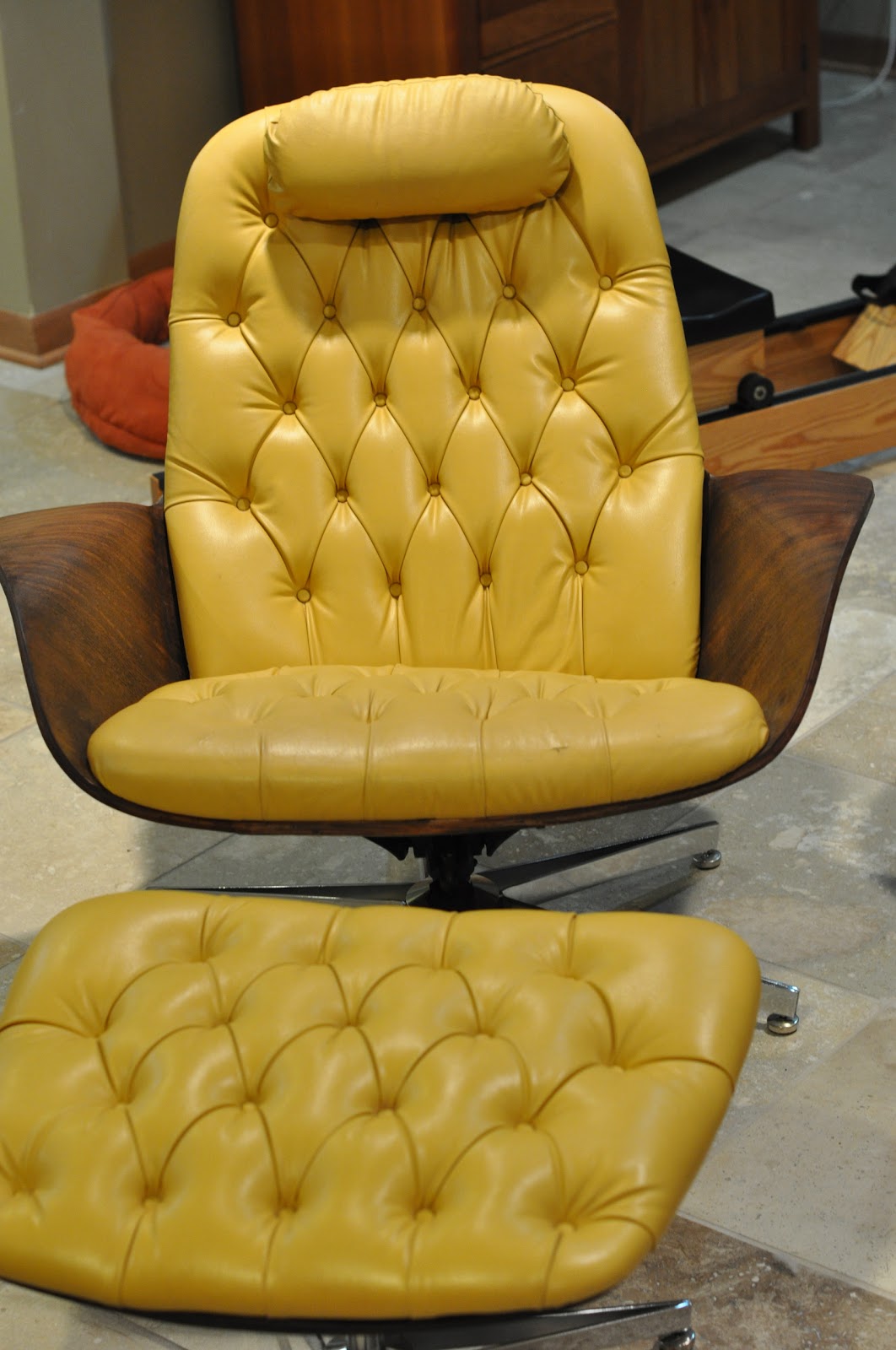
Mr. Chair for Plycraft by George Mulhauser – 1950s.   Mulhauser, and Plycraft for that matter, are probably best known as the mind(s) behind one of the better selling knock-offs of the seminal Eames Lounge Chair.   While not a bad chair in and of itself, the original is infinitely more palatable (flow, dimensions, etc.).    What has gone missing, at least to me, is the genius of the Mr. Chair.   Mr. Chair is an original design of the same era of the Eames Lounger.    One cannot help but wonder how Plycraft, and Mulhauser for that matter, might be seen had they come to be known for things like Mr. Chair instead of being the poor man’s Eames.   Fair disclosure – I have an Eames Lounger, and bought this as I wanted another of era original lounge chair that was meaningfully different.

While advertised as ready to roll, this one took some work, and will need more as the mechanical pieces are not an easy fix.  The seller (and his friend) started picking up items are garage sales over ten years ago (an “OG” if you will).   With baby #2 on the way, he was politely told that it was time to start getting rid of some stuff.   He wanted at least $250 for it, and I was able to take it home for $250 as the seller ended up living in my neighborhood and he also seemed to like that I planned on giving his old chair some TLC.   As with other projects, being “real” in the sourcing phase pays dividends.    This guy came to me in pretty bad shape – the arms were fully covered with the original yellow naugahyde (swank baby, swank), and the plywood was raw, dry.   The chair is essentially just a few pieces of cleverly bend ply with cushions – all hardware is exposed.   I decided to take it apart and refinish everything.   The back of the chair has a significant abrasion.  I was able to fill it and smooth it, but the scar is easy to see.   In addition, the seat panel of the chair was damaged by over-tightening of the base structure hardware some years ago.   I was able to fix most of the damage, but it remains another scar.    I decided to stain the ply dark as it appears that this was the designer’s original intent.  I also decided to keep the yellow pads – they look much better against the darker exposed wood that I expected.  As for the mechanical – the seat adjustment mechanism is missing what I assume to be a large rubber stopper.   I will need to keep an eye open for something that will work as original parts are hard to come by.   In the mean time, sitters need to be mindful of the lack of dampening as the chair rocks back into lounge position. 

I think a lot of people would have been upset to find the scars on this chair during the reworking process.  As with many of my other pieces, I like the story, especially the story of the designer and manufacturer.  It seems only fitting that this chair be a little less perfect than my Eames Lounger.  This is another beauty in the eye of the beholder case study, especially after the scars were discovered.        

In all, I am into this guy for $250 and a few days of work.   This is difficult to comp given the scars.   Models that claim to be in good shape appear to go for as much as ~$1,000.   I think $500 is probably fair for mine, especially as the models I have seen out there are all very plan black upholstery and mine has the swank yellow.

I am not looking to sell this chair at current, but if you are interested in finding one, or something similar, please ping me on the blog and we can go from there.  Given the extensive work I did on mine, I will also claim to be one of the few people around who has working knowledge of this chair to refinish another.  

3.08.2011

Retask, reclaim, rethink…


Design Idea – Wine Corks.  Wine cork presentation is an easy way to add warmth and dimension.   As with the bottles I mention in another post, the shape is pleasing to the eye.   Corks are another interesting way to add round and curved shapes to a room, which isn’t easy.   Natural cork is also not as prevalent as it once was, making the presentation almost a form of antiquing.  

Here I show a few ways we use old bottles.   In the first, I simply fill a clear vessel with corks and display them among other objects.   In the second, I have taken the corks and created a custom cork board.  The frame was built using remnant tongue and groove flooring and some thin plywood as the backing.    One could just as easily use a store-bought new or vintage frame and some cardboard to create the structure and simply glue corks on as you see fit.     

A special thanks to Chase for getting me the pics of the cork board.